
Trading gold from a banking app.
Gold is a default asset in a Swiss portfolio, but buying it was still an analogue errand. This shipped as a standalone MVP to prove the demand, then moved into UBS Mobile Banking, through pilot users, and out to domiciled clients in stages.
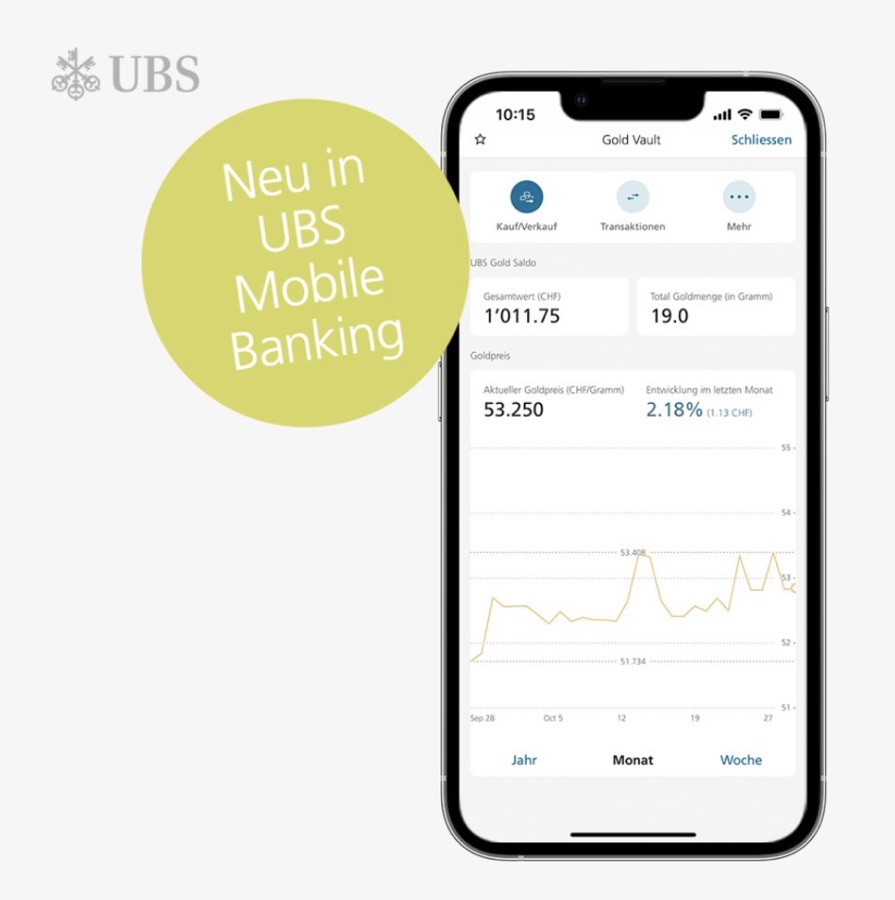
Everyone wants gold. Nobody wants the errand.
In Switzerland, physical gold isn't an exotic asset. It's a normal part of how households hold value. The demand was never the question. The path to owning it was.
Buying gold the traditional way meant a dealer or a branch appointment, bar sizes that set the entry price far above what most people wanted to commit, and pricing you couldn't easily compare. Then the part nobody plans for: once you own a bar, you have to keep it somewhere and insure it. And when you want to sell, you have to go and find a buyer.
Entry was gated by physical bar sizes rather than by how much a client actually wanted to invest.
Storage and insurance became the client's problem the moment they took delivery.
Selling meant finding a counterparty: the asset was liquid in theory, inconvenient in practice.
Clients who did everything else in an app had no digital route into a mainstream asset class.
The bank's side of the problem was distribution. Gold sat behind advisory and branch channels, so it reached the clients who asked for it and effectively nobody else, while the segment growing fastest expected to open, fund and trade from a phone.
Prove it standalone. Scale it through the bank.
Building gold trading directly into UBS Mobile Banking as a first move would have meant committing to the bank's release train, its regulatory review and its entire client base before knowing whether anyone would buy gold from a phone at all.
So the sequence was deliberate: ship a standalone app as the MVP, prove the demand and the mechanics with real money and real clients, and only then earn the right to sit inside the bank's flagship app, where the distribution is.
MVP outside the core
A standalone app could move at its own pace and be discarded if the thesis failed. Validation first, integration second.
Remove the ownership burden
Clients own physical gold held in a UBS vault, with delivery to their home address if they want the bars. Ownership without the logistics.
Earn scale in stages
Integrate, pilot with a controlled group, then widen by domicile, so entitlement and compliance were proven before volume arrived.
MVP, then integration, then reach.
Five stages, each one earning the next. The standalone MVP de-risked the proposition; the integration de-risked distribution; the pilot and the domicile-by-domicile rollout de-risked compliance and volume.
Standalone MVP
Shipped gold buying and selling as its own app: the smallest thing that could prove clients would trade a physical asset digitally, without waiting on the bank's release cycle.
Validate the thesis
Real transactions, real custody, real support load. The MVP answered whether demand existed and what the operational reality of vaulted gold and home delivery actually looked like.
Integrate into Mobile Banking
With the proposition proven, gold moved inside the bank's flagship app, reusing existing authentication and entitlement so there was no second login and no second onboarding.
Pilot group
Released to a controlled set of pilot users first, to test the integrated journey and the entitlement rules at low volume before exposing the wider base.
Phased rollout by domicile
Widened progressively to other domiciled clients. Domicile drives eligibility for a regulated product, so rollout was staged deliberately rather than switched on at once.
Borrowed patterns, not new ones.
The MVP proved the flows; the integration had to make them feel native. Rather than porting the standalone app's interface, every screen was reassembled from the bank's existing mobile design system: components clients already recognised, which removed the need to teach anything new and shortened accessibility and brand review.
Flows were prototyped in Figma and walked through with compliance, front-office and engineering in the same room, deliberately, because a gold trade has regulatory constraints that surface faster in conversation than in a document. What emerged: an entry point inside the client's portfolio view, a vault screen showing holdings against live CHF pricing and performance history, and buy/sell flows that reused the bank's existing confirmation and audit patterns.
Shipped in slices, inside the bank's cadence.
Delivered as Product Owner across Agile and hybrid sprints, feeding into the Mobile Banking portfolio's existing release train. I owned the backlog and the release sequencing, converting requirements into shipped increments and running RAID across the migration: the dependency on the bank's authentication service and the pricing feed were the two risks tracked hardest, because either could stop a release.
Governance updates, release status and risk summaries went to senior stakeholders every cycle. Over the programme this scaled into governance across 8 agile crews in the wider Mobile Banking portfolio.
The MVP proved the demand, and gold shipped successfully into UBS Mobile Banking, reaching pilot users first, then domiciled clients in stages. The banking application it became part of sustained CSAT above 4.5/5 and an estimated annual revenue contribution exceeding CHF 3M, with digital banking releases in this portfolio reaching 20K+ users.
Figures are portfolio-level for the digital banking application this feature became part of, not attributable to Gold Vault alone.