
Keeping customers, not just winning them.
A SaaS retention platform that tells a business which customers are about to leave and acts before they do. Built as an AI-driven engagement engine for enterprise and mid-market clients.
Churn is noticed too late.
Marketing teams are measured on acquisition and instrumented for it. Retention is where the margin actually is, and it's the part they can least see. By the time a customer shows up in a churn report, the relationship has usually already ended.
Teams can't tell which customers are disengaging until the revenue has already gone.
Campaigns are sent to broad segments, so the customers most at risk get the same message as everyone else.
Engagement data sits across e-commerce, CRM and messaging channels with no single view.
Nobody can attribute revenue to a retention action, so retention work loses the budget argument to acquisition.
Make retention measurable, then make it automatic.
The strategy was deliberately sequenced: prove attribution before selling automation. A platform that automates outreach without showing the revenue it protected is a cost line; one that can attribute revenue earns its renewal. Three principles shaped the roadmap:
One view of the customer
Unify engagement signals across channels first. Every later capability depends on that single view being trustworthy.
Attribution as the product
Show assistant-attributed revenue explicitly, so a client can defend the spend internally at renewal.
Multi-tenant from the start
Built to onboard the next client without bespoke work: the difference between an agency and a SaaS product.
Instrument, then act, then scale.
Unify the data
Integrations across e-commerce, CRM and messaging channels into one engagement view. Unglamorous, and the dependency everything else sat on.
Segment & score
Active-segment revenue and engagement scoring, so teams could finally see which cohorts were slipping.
AI-assisted engagement
Assistant-driven outreach targeted at at-risk segments rather than broadcast to the whole base.
Attribution & reporting
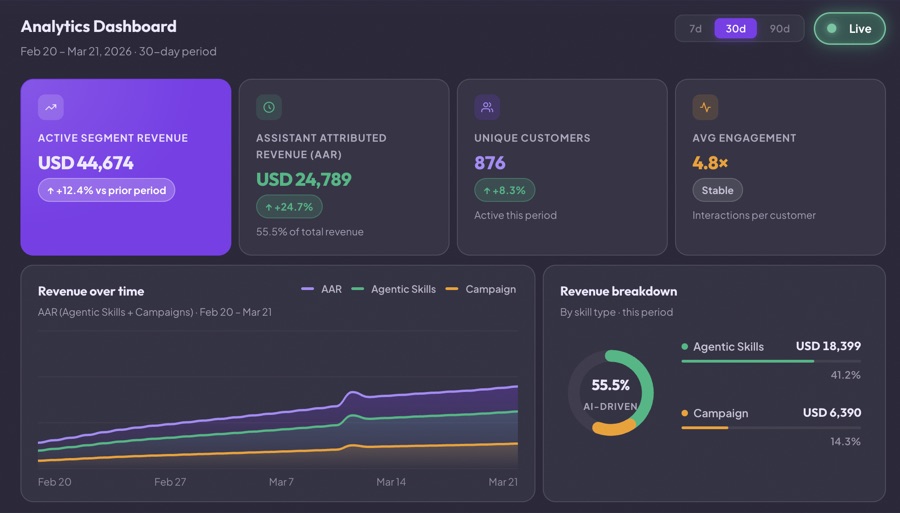
The dashboard that closes the loop: assistant-attributed revenue, campaign breakdown, revenue over time.
Scale across clients
Repeatable onboarding so each new client was a configuration exercise, not a build.
Designed around the renewal conversation.
The dashboard was designed backwards from the meeting where a client justifies the subscription. That framing decided the hierarchy: active segment revenue and assistant-attributed revenue sit at the top, because those are the two numbers a client repeats to their own leadership. Unique customers, average engagement, revenue over time and campaign breakdown support them.
Prototyped in Figma and iterated with client feedback in a continuous loop rather than a one-off research phase, because what a retention team needs to see changes as their own maturity changes.
25 people, one roadmap.
Delivered as Senior Project Manager owning the product roadmap and end-to-end execution, leading 25 people across product, engineering, QA and design through Agile and hybrid sprints. I ran RAID across parallel initiatives. With several client integrations live at once, dependency gaps between them were the standing risk, not individual features slipping.
Azure cloud knowledge fed platform planning and integration requirements, keeping engineering, product, client, e-commerce and messaging-channel stakeholders aligned on what shipped when.
The platform shipped and scaled to 6+ enterprise and mid-market clients, reaching 250K+ end-users. KPI tracking across engagement, retention and campaign metrics drove an 18–22% engagement uplift and a 12–15% improvement in retention-campaign performance.